
A 1920s Upright Piano Out of an Englewood Basement, One Flight Up.
By Darius Schultz, owner · Updated
An Englewood customer had a century-old upright in the basement that six people had carried down years ago. Here is how it came back up in pieces, what it cost, and what we would do differently.
Cast-iron plate, extremely heavy, in the basement
South Denver metro
Found us online, piano gone that day
Including the basement cleanup after
One dump-station stop, shared the trailer with another load
$599 to $699 under today's starting rates: $349 to $449 + $150 flight + $100 breakdown
Basement empty the same day, four-star Google review afterward.
Have a piano that needs to go? Text us a photo of the piano and the stairs and we will text back your price.
A Century-Old Upright at the Bottom of the Stairs.
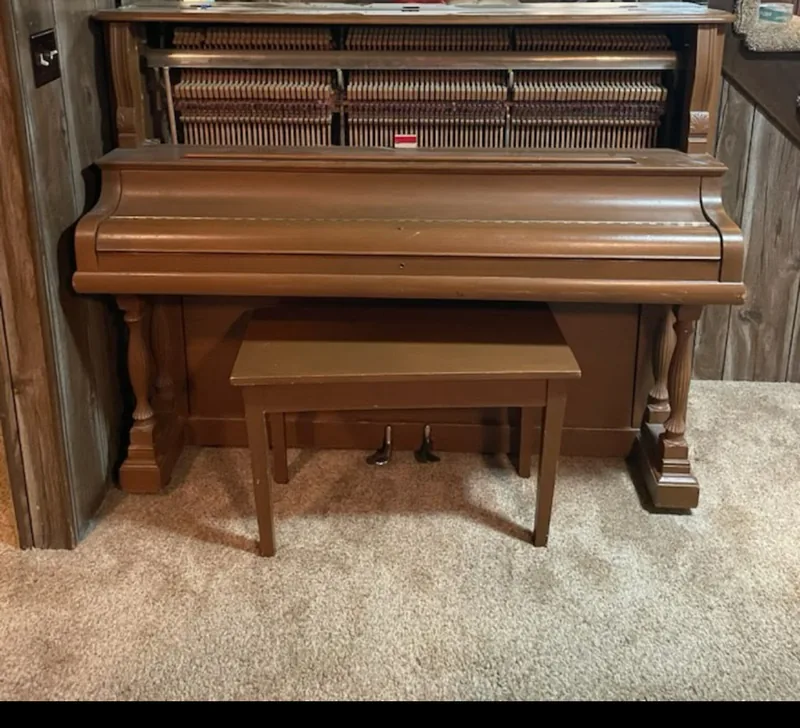
On August 20, 2026, a customer in Englewood found us online and reached out about a piano. Not a spinet in the living room by the front door. An upright from the 1920s, sitting in the basement, at the bottom of a full flight of stairs.
The detail that should have set the price came out early: the customer said it took six people to get the piano down there in the first place. Old uprights are built around a cast-iron plate that holds thousands of pounds of string tension, and that plate is where most of the weight lives. This was not a dolly-it-out job. It was a break-it-down job.
Darius had room in the day, so it was booked and handled that same day. The trailer already had another load on it from earlier, which turned out to matter for the disposal math later.
Cut It Down, Carry It Up, Or So the Plan Went.
The plan on arrival was simple: take the piano apart with a reciprocating saw into pieces small enough to carry, walk them up the stairs, and load the trailer. The wooden case cooperated. The inside of the piano did not. Here is what actually did the work by the end of the day.
What the saw could not cut, the sledge fractured. Cast iron breaks, it does not bend.
Lifting straps that put the heavy plate sections on the shoulders instead of the fingers.
One full flight, every piece, one trip at a time. The stairs are the whole reason this job costs what it does.
Breaking up cast iron and old wood indoors makes dust and debris. The basement got cleaned before leaving.
Saw first, sledgehammer second, straps for the heavy sections, broom last. One trailer, one dump-station stop.
The Part Where the Saw Lost.
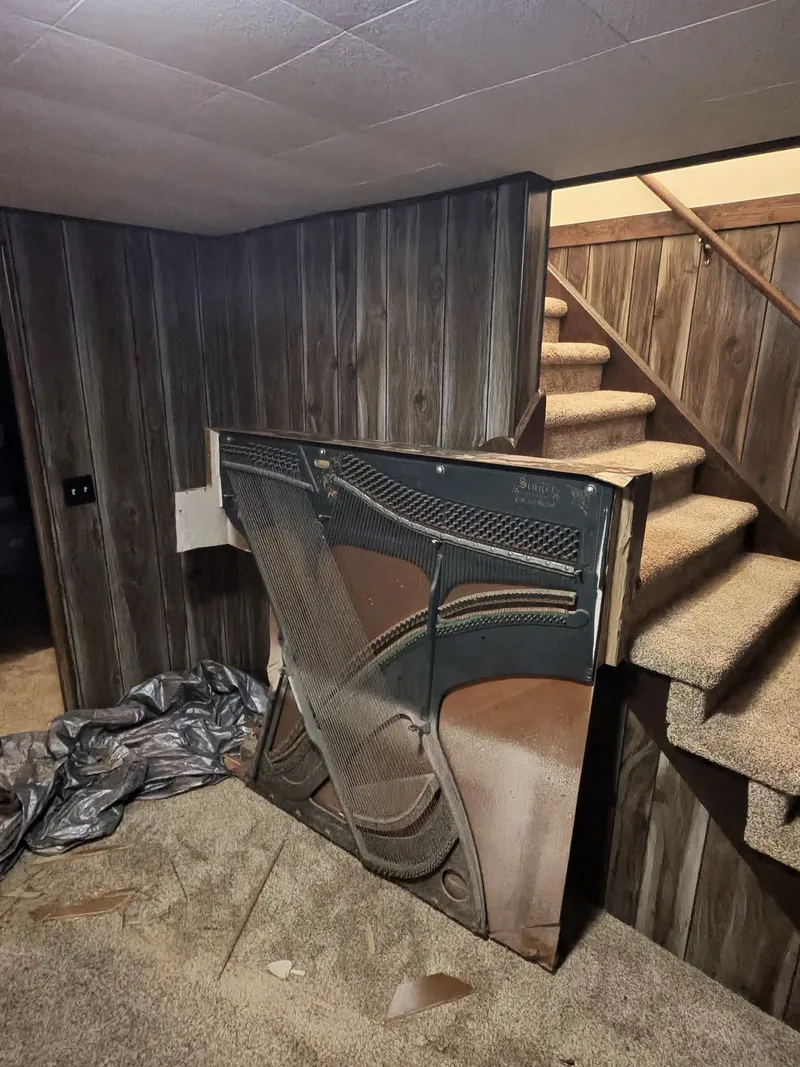
The reciprocating saw went through the outer case fine. Then it hit the plate inside and stopped making progress. Not slow progress. None. A metal blade on that plate was doing nothing but heating up.
So the research happened right there in the basement. The plate inside an old upright, sometimes called the harp or the backboard, is cast iron. Cast iron is strong under compression and brittle under impact, which means it does not cut well and it does not bend at all. What it does is fracture. Hit it hard enough in the right spot and it breaks into chunks.
That changed the whole method. A sledgehammer and a set of shoulder-dolly lifting straps were brought in. Darius broke the plate into sections, and the heavy pieces went up the stairs on the straps instead of in anyone's arms. The rest of the piano was cut into pieces and carried out. Not the plan we walked in with, but the plan that worked. The piano still left either way, and that is the part that matters.
Up the Stairs in Pieces, Then the Broom.
Once the plate was in sections, the job turned into a long series of trips up one flight of stairs: plate chunks on the straps, case pieces and the rest by hand, all of it onto the trailer next to the load that was already there. Nothing was salvaged. A 1920s upright that has spent years in a basement has no resale market, and this one left in pieces. Everything was dumped or scrapped.
Breaking up cast iron and old wood inside someone's basement makes dust and debris, so the last stretch of the job was cleanup. The basement got swept and cleared before Darius left. Total time on site: roughly 3 to 4 hours including that cleanup, which is longer than it will take next time, for reasons covered below.
From there the trailer went to the dump station. Because the piano shared the trailer with another load, its share of the disposal came to about $60 on a single stop.
Basement upright, one flight of stairs, broken down on site
Upright removal is $349 to $449 on the piano removal page, for the ground floor with a clear path, depending on the piano. Under today's starting rates this job is $349 to $449 + $150 for the flight of stairs + $100 for the breakdown, or $599 to $699. In August it was charged $600, quoted on site before anything was lifted. Piano prices are starting rates for a typical job. The exact price is confirmed from your photos and again on site before anything is lifted. Everything else is priced by the yard on the pricing page.
Four Things This Piano Taught Us.
This was the first piano job, and the most useful thing to come out of it was not the $600. It was the list of what to do differently. We are publishing it because the next customer with a basement piano benefits from every one of these.
1. It should have been priced higher. A basement piano with a full flight of stairs and an on-site breakdown is a different job from an upright by the front door. $600 covered it, but between 3 to 4 hours of labor, the extra equipment, and the cleanup, the honest number for a job like this is higher than what was charged. That lesson is why piano prices are now published as a range with starting rates: $349 to $449 on the ground floor depending on the piano, $150 for every flight, and $100 for a breakdown, written down before the first lift. The exact price is confirmed from your photos and again on site.
2. Bring more cleanup equipment. Specifically a higher-powered vacuum. Fracturing cast iron and cutting old wood indoors makes fine dust and sharp debris, and a broom alone is a slow way to get a basement back to the way it was.
3. Prep the space before the first swing. Floor protection down and dust control up before any breakdown happens inside a customer's basement. That prep takes a few minutes at the start and saves a lot of cleanup at the end.
4. An old upright is heavier than it looks. The customer's "six people" story was accurate. The cast-iron plate alone is the kind of weight that needs straps and a plan, not a strong back and good intentions. Respecting that from the first minute is what keeps the walls, the stairs, and the person carrying it intact.
Ground Floor or Basement Is the Whole Price Question.
If you are pricing a piano removal in the Denver metro, this job is the clearest example we have of what moves the number. A ground-floor upright with a clear path to the door is $349 to $449, depending on the piano: spinets at the low end, full-size, player, and antique uprights at the high end. Each flight of stairs adds $150 (a flight is 4 or more steps; 1 to 3 steps at a door or porch are part of the path), and a breakdown on site adds $100, which is how a basement upright like this one comes to $599 to $699 under today's starting rates. This one was charged $600.
That is why the piano price on the piano removal service page is written as a starting range of $349 to $449 plus the stairs and the breakdown, and the final price is confirmed on site, because the stairs and the path out cannot be guessed from a phone call. Text a photo of the piano and the stairs and you get a straight answer before anyone drives out.
For the full breakdown of what pushes a piano job up or down, read the piano removal cost guide. For how piano pricing fits next to everything else we haul, the junk removal cost guide covers the per-yard rate.
Basement Back, Piano Gone, Same Day.
The customer got the basement back the same day they reached out, without hunting for six friends, renting a truck, or figuring out where a cast-iron plate is allowed to go. The piano that had been the immovable object at the bottom of the stairs was gone by evening, and the floor was cleaned up behind it.
The customer, Sharon S., left a four-star Google review afterward: “Worked hard and did a good job.” Four stars, not five, and we think the missing star is the cleanup lesson above. We took the longer list of lessons and put it to work on the next one.
About This Piano.
What does it cost to remove a piano from a basement?
Why did the piano have to be broken up instead of carried out whole?
Was any of the piano salvaged or recycled?
How long does a basement piano removal take?
Is this a real job?
Keep Reading.
Uprights, spinets, and consoles, with the dolly, straps, and a plan for the stairs.
What piano removal costs in Denver and what the stairs and a breakdown add.
How per-yard pricing works, from a single item to a whole house.
The per-yard rate and the yard table in one place, the same numbers customers actually pay.
Snap a Photo of the Items, Get a Price
Drop your number below. Darius texts your price back, usually within 10 minutes during business hours.
Got it!
Darius will text you a price shortly. Keep your phone handy. The reply comes from (720) 689-3713.
In a hurry? Call now and skip the wait.